
Master of Business Administration : Fees, Admssion 2026, Eligibility, Cut-off, Syllabus, Placement
2 Years | Post Graduate | Management
Master of Business Administration
An MBA (Master of Business Administration) is a postgraduate management program designed to build advanced knowledge and practical skills in business, management, and leadership. The program helps learners understand how organizations operate and how effective decisions can be made in today’s competitive business environment.
Through an MBA, students can develop expertise in key areas such as Finance, Marketing, Human Resources, Operations, Business Analytics, Entrepreneurship, and Strategic Management. The course focuses on developing problem-solving, communication, analytical, and leadership abilities that are valuable across different industries.
An MBA can prepare learners for a wide range of managerial, administrative, and leadership opportunities, while also providing a strong foundation for those interested in entrepreneurship or growing their existing business.

Why Choose an MBA?
An MBA provides learners with a strong foundation in modern business and management practices. The program helps develop essential skills in leadership, strategic thinking, communication, problem-solving, and decision-making. Students can explore different areas of management while gaining knowledge that can be applied to real-world business situations.
MBA Program Highlights
Program
Master of Business Administration
Duration
2 Years
Level
Postgraduate Program
Mode
Online / Distance Learning
Ready to Start Your MBA Journey?
Get personalized guidance to choose the right MBA program, university, specialization, and learning mode.
Get Free Counselling →MBA Course Specifications
Explore the key details of the Master of Business Administration program, including duration, eligibility, learning mode and course structure.
| Specification | Details |
|---|---|
| Course Name | Master of Business Administration (MBA) |
| Course Level | Postgraduate |
| Duration | 2 Years |
| Eligibility | Bachelor's Degree from a Recognized University |
| Mode of Learning | Online / Distance Learning |
| Specializations | Finance, Marketing, Human Resources, Business Analytics, Operations & More |
| Course Structure | Semester-based |
| Assessment | Assignments, Examinations & Projects |
| Medium of Instruction | English |
| Career Opportunities | Management, Marketing, Finance, HR, Operations & Business Roles |
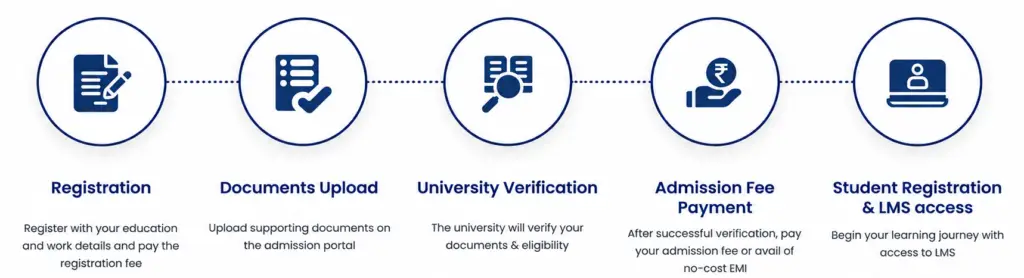
Admission Process
Top in-demand Online MBA Dual Specializations for 2025
| Dual Specialization | Key Focus Areas | Key Focus Areas |
|---|---|---|
| 1. Cybersecurity and Logistics | Combines studies of security protocols with supply chain and logistics management. | Roles in security management, supply chain oversight, and risk management. |
| 2. Marketing and Operations Management | Integrates core marketing strategies with operational processes to enhance business efficiency. | Marketing director, operations manager, business strategist. |
| 3. Accounting and Taxation | Focuses on financial reporting, tax compliance and strategy, essential for financial health of organizations. | Financial analyst, tax advisor, chief financial officer. |
| 4. Analytics and Finance | Merges quantitative analysis and financial management to support data-driven decision-making in finance. | Financial analyst, data scientist, investment banker. |
| 5. Accounting and Finance | Combines expertise in financial operations and accounting principles. | Roles in corporate finance, accounting management, and financial consulting. |
| 6. Marketing and Human Resource Management | Bridges the gap between product/service marketing and managing organizational talent. | Marketing manager, HR manager, corporate trainer. |
| 7. Analytics and Marketing | Combines data analytics with marketing strategies to drive business decisions based on data insights. | Digital marketing manager, business analyst, and marketing strategist. |
| 8. Human Resource Management and Organizational Leadership | Focuses on strategic human resource management paired with leadership skills to drive organizational change. | HR director, organizational development consultant, and executive leadership roles. |
Online MBA Education Course Subject
| Online MBA Subjects: First Year | |
|---|---|
| Semester 1 | Semester 2 |
| Quantitative Methods | Management Science |
| Business Communication | Operation Management |
| Organizational Behaviour | Organization Effectiveness and Change |
| Information Technology Management | Management Accounting |
| Financial Accounting | Financial Management |
| Marketing Management | Management of Information System |
| Human Resource Management | Economic Environment of Business |
| Managerial Economics | Marketing Research |
| Online MBA Subjects: Second Year | |
|---|---|
| Semester 3 | Semester 4 |
| Legal Environment of Business | Strategic Management |
| Strategic Analysis | International Business Environment |
| Business Ethics & Corporate Social Responsibility | Project Study |
| Elective Course | Elective Course |
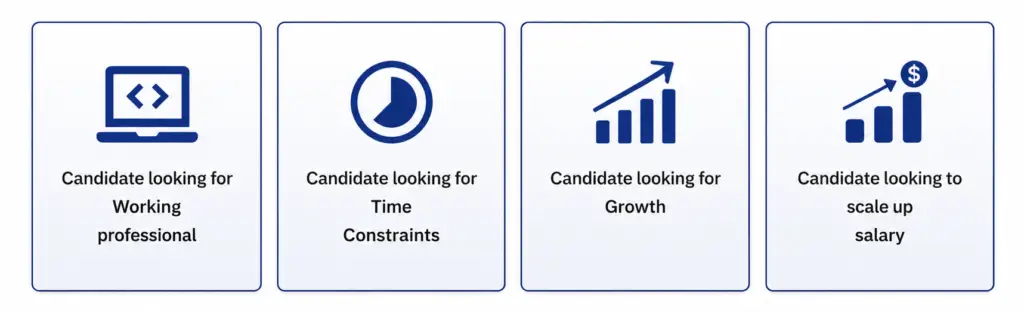
Who Should Enroll
How Online MBA Exams are Conducted?
- Remote Proctoring: This is a common feature where software monitors the students as they take their exams. Remote proctoring can include live monitoring or automated using artificial intelligence. The software typically checks for suspicious eye movements, background noise, and other indicators.
- Secure Browsers: Some online exams require students to download a secure browser that restricts the ability to open other tabs, use certain keystrokes, or take screenshots. This helps prevent students from accessing online resources or notes during the exam.
- Timed Exams: Exams might be timed to limit the amount of time students have to answer the questions, which helps reduce the chances of looking up answers elsewhere.
- Multiple-Form Tests: Some programs administer tests that have multiple versions of the same exam. Each student receives a slightly different version, with questions that are either different or presented in a different order. This reduces the risk of students sharing answers.
- Assignments and Projects: As part of the assessment strategy, students might also be required to complete projects, presentations, and assignments that demonstrate their understanding of the material over a period, which can be more reflective of their true capabilities than a timed test.
- Virtual Viva and Oral Exams: Some programs include oral exams or vivas conducted via video conferencing tools, where students must answer questions live, demonstrating their knowledge and thinking process on the spot.
Entrance Exams for Online MBA Programs
While the convenience of online MBA programs is undeniable, admission involves a standardized entrance exam. Entrance exams are a crucial step in the online MBA application process. By understanding the different types of exams, their importance for specific programs, and how to prepare effectively, you can increase your chances of gaining admission to your chosen online MBA program. Here’s a breakdown of entrance exams for online MBA programs:
Types of Entrance Exams
National Exams
- GMAT (Graduate Management Admission Test): Widely accepted for global MBA programs, the GMAT assesses quantitative, verbal, analytical writing, integrated reasoning, and critical thinking skills.
- GRE (Graduate Record Examinations): The GRE is primarily used for non-business graduate programs, but some online MBAs might accept it, especially for programs with a strong quantitative focus.
- CAT: India has its own entrance exams for MBA programs, such as the Common Admission Test (CAT) or the GMAT. Their requirement might be considered for government universities, such as IIM.
Is Online MBA Acceptable in the Job Market?
The acceptance of an online MBA degree in India in today’s job market reflects the shift in higher education and professional development. With the increasing demand for flexible learning options, online MBA programs have become popular among aspiring business leaders. There are several factors that contribute to the perceived worth of an online MBA in the job market.
Accreditation plays an important role, as employers recognize degrees from accredited institutions that meet rigorous academic standards. The reputation of the university offering the online MBA, faculty credentials, and program rankings also influence its credibility. The skills and knowledge gained through practical coursework, case studies, and interactive online discussions prepare graduates for real-world challenges, enhancing their employability.
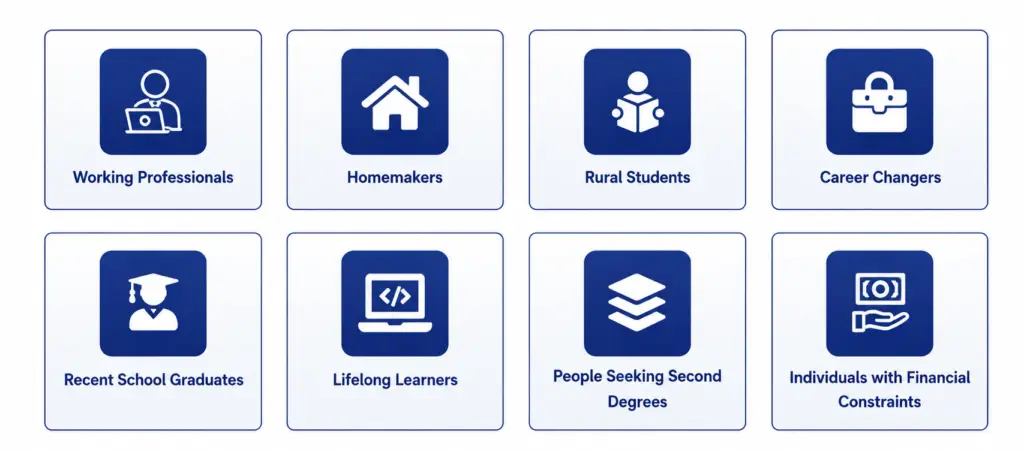
Who Can Apply for MBA Distance Learning Courses?
FAQ'S
The validity of an online or distance degree depends on the university and the applicable regulatory approvals. Students should check the recognition and accreditation status of the university and program before enrolling.
Eligibility varies depending on the course and university. Generally, undergraduate programs require completion of Class 12, while postgraduate programs require a relevant bachelor’s degree from a recognized university.
Students can generally apply online by submitting their academic details and required documents. Depending on the university and program, admission may be based on eligibility, merit, or an entrance examination.
Depending on the program, learning may include recorded or live lectures, digital study materials, assignments, projects, and online or designated examination arrangements. The exact assessment process varies by university.
Recognition and accreditation vary by institution and program. Students should refer to the university’s official recognition and accreditation information before making an admission decision.
Course fees vary according to the university, program, and specialization. Many institutions offer semester-wise or installment-based payment options. Students should check the latest fee structure and available payment options before admission.